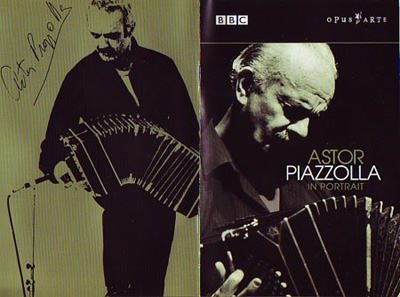
Tango Maestro: The Life and Music of Astor Piazzolla
2004-05 BBC/DD 106’
Exploring Piazzolla’s vibrant musical influence around the world, this film charts the events of his turbulent, complicated personal and professional life through candid and revealing interviews with Piazzolla himself, his family, friends and the great Argentinian musicians who performed with him.
Contributions from other virtuoso performers drawn to his music, including Daniel Barenboim- a fellow student of Nadia Boulanger, cellish Yo-Yo Ma, jazz vibraphonist Gary Burton, the Kronos Quartet, the Paris-based Gotan Project, the Tango Pasión dance company, British pianist Joanna MacGregor, Scottish accordeonist James Crabb and Astor’s close friend Richard Galliano, the French accordeonist and bandeoneon player.
____
Astor Pantaleon Piazzolla was born on 12th March, 1921 in Mar del Plata, Argentina, as the only child of poor Italian immigrants.
The family moved to New York City when Astor was four. His father gave him his first bandoneon when he was nine which he has bought at a pawn shop for $19. In addition to lessons on that instrument, Piazzolla also studied with classical pianist Bela Wilder in 1933, becoming an ardent fan of Bach and Rachmaninov. Around the same time, the budding prodigy met and played with Carlos Gardel, appearing as a newspaper boy in Gardel’s watershed tango film, El Dia Que Me Quieras. In 1937, Piazzolla’s family returned to Mar del Plata, and his passion for tango music was fired anew by violonist Elvino Vardaro’s sextet. At only 17, Piazzolla moved to Buenos Aires, seeking work as a musician. He played in a few tango orchestras until 1939 when he realised his dream of playing bandoneon with the widely renowned Anibal Troilo Orchestra, where he spent several high profile years.
In the meantime, he continued his study of piano and music theory, counting future classical composer Alberto Ginastera (1941) and pianist Raúl Spivak (1943) as his teachers. He began composing for Troilo during this period, although his more ambitious, classically-influence pieces were often edited for accesibility’s sake. In 1942 he married Dedé Wolff, with whom he had two children, Diana in 1943 and Daniel in 1944.
In 1944, Piazzolla left Troilo’s group to lead the orchestra accompanying singer Francisco Fiorentino. Two years later he formed his own group, playing mostly traditional tangos yet already with hints of modernism. This group broke up in 1949 and Piazzolla, unsure of his musical direction, saught a way to leave tango behind for more refined pursuits. He studied Ravel Bartók and Stravinsky, also immersing himself in American jazz, and for the next few years worked mostly on his compositional skills. His 1953 piece Buenos Aires caused a stir for its use of bandoneon in a classical orchestral setting.
In 1954, Piazzolla won a scholarship to study in Paris with the hugely influential Nadia Boulanger, who encouraged him not to ignore tango but to reinvigorate the form with his jazz and classical training. On his return home, he formed an octet that played tango as self-contained chamber music, rather then as an accompaniment for vocalists or dancers. The howls of protest from traditionalists continued unabated until 1958, when Piazzolla disbanded the group and went to New York City. There he worked as an arranger and experimented with a fusion of jazz and tango, also composing the famed Adiós Nonino, an ode to his recently departed father.
Returning to Buneos Aires in 1960, Piazzolla formed his first quintet, the “Quinteto Tango Nuevo”, which would become the primary vehicle for his forward-looking vision. In 1963, under the direction of Paul Klecky, he premiered Tres Tango Sinfonicos, and in 1965 he made two of his most important records- one, of his concert at New York’s philharmonic hall and the other, El Tango, a product of his friendship with poet Jorge Luis Borges. In 1967 Piazzolla collaborated with poet Horacio Ferrer to produce the groundbreaking so-called “Operita” Maria de Buenos Aires, which was premiered in 1968 by singer Amelita Baltar (who became Piazzolla’s lover, and lived with him for the next seven years). Piazzolla and Ferrer next worked together on a series of “tango-canciones” (tango songs) producing his first genuine commercial hit, Balada para un Loco (“Ballad for a Madman”) in 1969. In addition to composing songs and more elaborate pieces for orchestra, Piazzolla also scored numerious films of the period.
The seventies started out well for Piazzolla, as an acclaimed European tour gave him the opportunity to form a nine-piece group, “Conjunto 9”- the ideal chamber music formation he had always wanted. However, all was not well. Argentina’s government was taken over by a conservative miltary faction, and everything that Piazzolla symbolised suddenly became politically unwelcome. In 1973, Piazzolla suffered a heart-attack and he decided after his recovery that, with sentiments running high against him, it would bew wiser for him to live in Italy. There he formed a group called the “Conjunto el Electronico”, which placed the bandoneon at the forefront of what was essentially an electric-jazz ensemble. This period also produced one of his most celebrated compositions, Libertango. In 1974, he seperated from Amelita Baltar. That same year he cut an album, Summit, with jazz baritone saxiphonist Gerry Mulligan, backed by Italian musicians. In 1975 he found a new favourite vocal interpreter in Jose Angel Trelles. In that year Anibal Troilo died, and Piazzolla composed the Suite Troileana in his memory. In 1976, he met Laura Escalada, who later became his second wife. That December he played an extraordinary concert back in Buenos Aires at the Gran Rex theatre with the “Conjunto Electronico”, premiering the piece 500 Motivaciones, and the folowing year he played another memorable concert at the Olympia in Paris.
Tiring of electric music, Piazzolla formed a new quintet in 1978 and toured the world extensively whilst also composing new chamber and symphonic works. In 1982 he wrote Le Grand Tango for cello and piano, dedicated to Russian cellist Mstislav Rostropovich and premiered by him in 1990 in New Orleans. In June 1983 he played a concert at the Teatro Colón in Buenos Aires which included the Concert for Bandoneon and Orchestra. His reputation grew steadily, making him a prime candidate for exposure in the US during the world-music craze of the latter half of the 80s. in 1986, Piazzolla and his quintet, with American producer Kip Hanrahan, recorded what he considered the finest album of his career, Tango: Zero Hour”. That same year he played the Montreux Jazz Festival with vibraphonist Gary Burton, resulting in the recording Suite for Vibraphone and New Tango Quintet. He won equally glowing reviews for The Rough Dancer and the Cyclical Night and staged a major homecoming concert in New York’s Central Park in 1987.
Unfortunately, at the height of his international fame, Piazzolla began to fail him and he underwent quadruple bypass surgery in 1988. He recovered well enough in 1989 to mount an international tour, having formed the “New Tango Sextet”, with the unprecedented inclusion of two bandoneons. it was during this tour that he came to the BBC in Bristol, England to record the historic ‘Tango Nuevo’ programme included in this film. The tour also included what would be his final concert in Argentina, at the Teatro Opera in Buenos Aires. That same year, the recording of La Camorra was released, and in 1990 he recorded a short album with the modern-classical Kronos Quartet, entitled Five Tango Sensations. Sadly, shortly after that, Piazzolla suffered a stroke that left him unable to perform or compose. After two retched years in intensive care, he died on 4th July 1992 in his beloved Buenos Aires, leaving behind a monumental legacy as one of South America’s greatest musical figures ever, and a major composer of the twentieth century.